
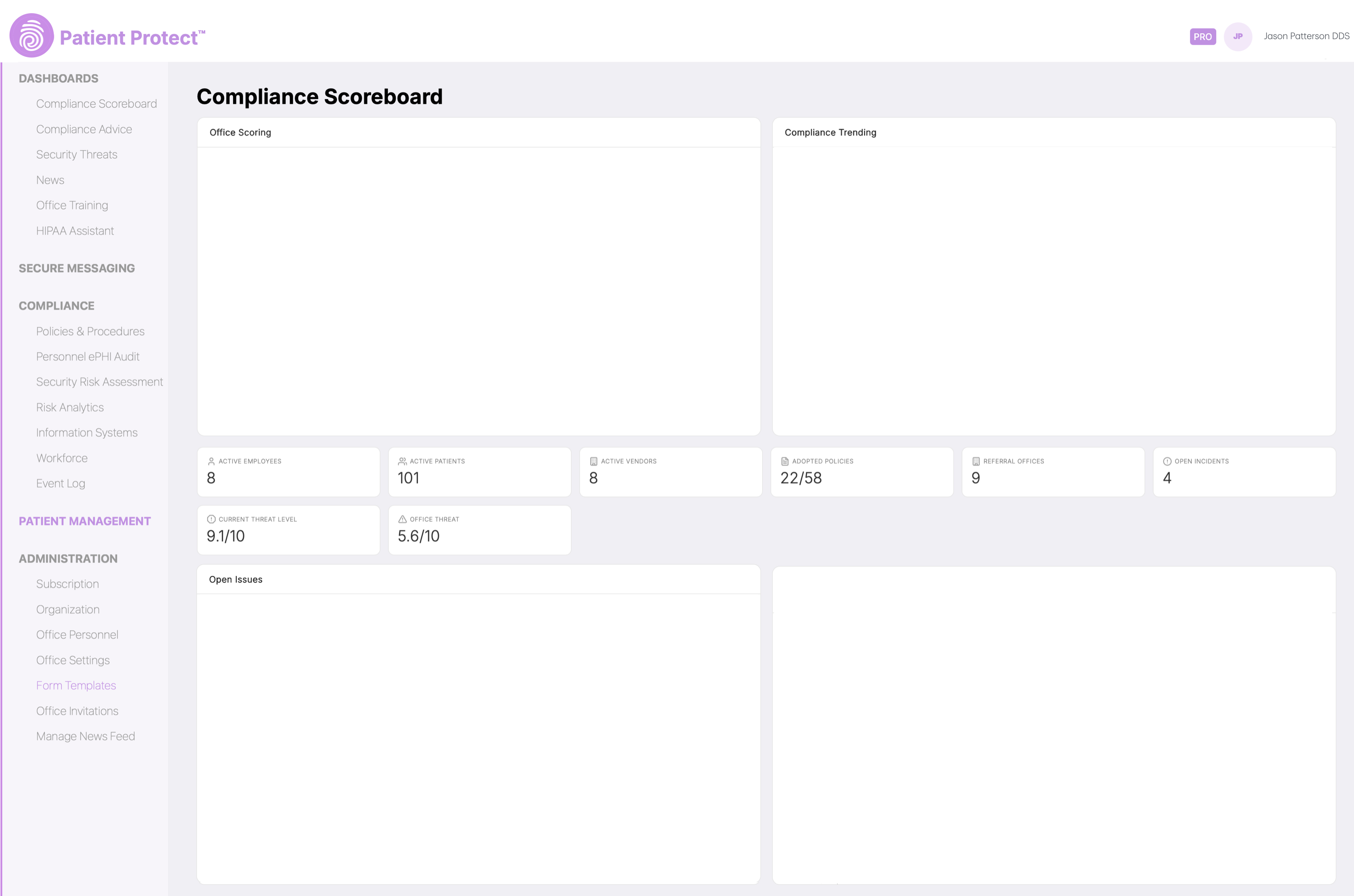
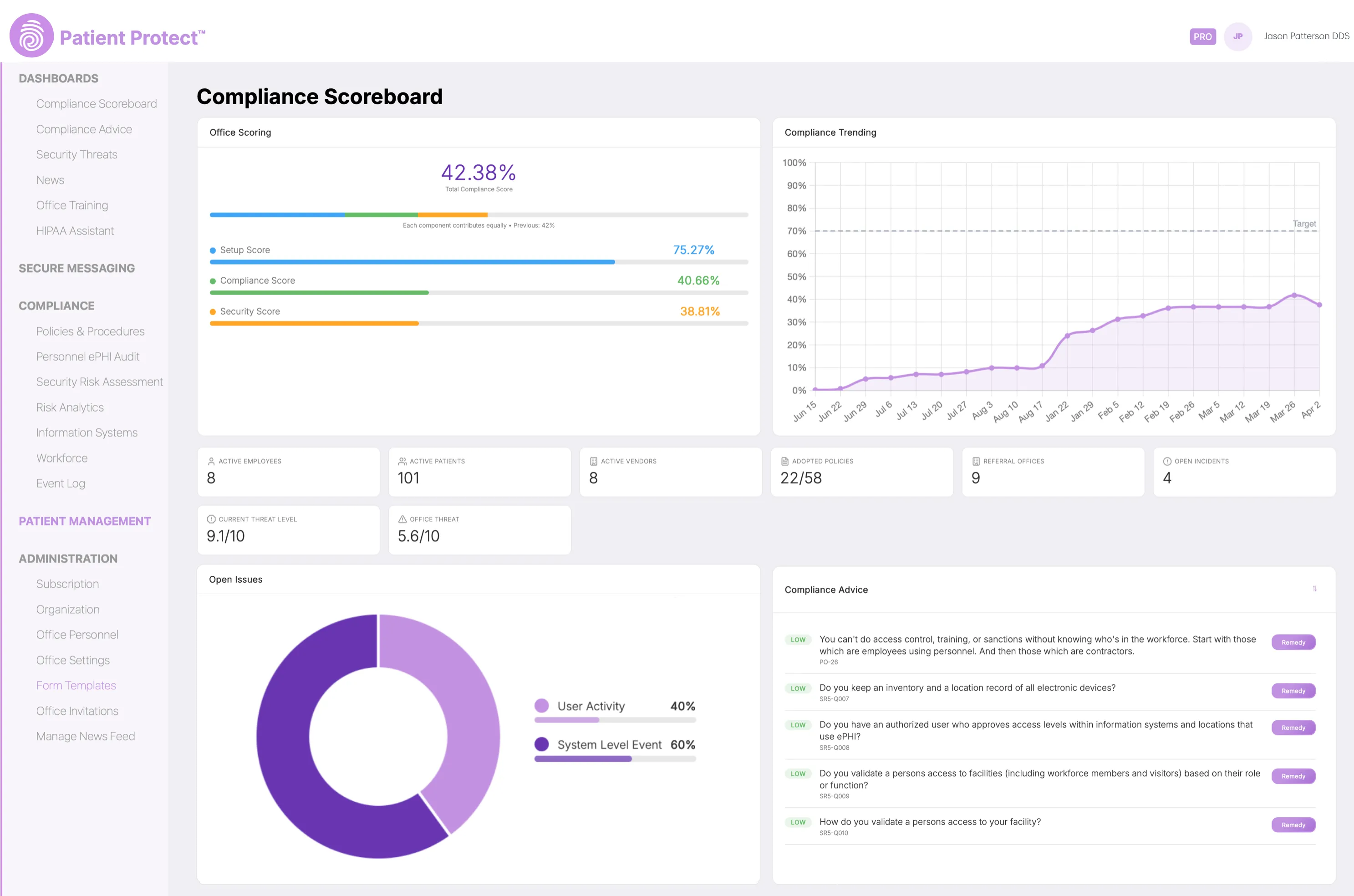
See the state
Understand where the practice stands today.
Current compliance score, unresolved risks, overdue requirements, vendor status, and workforce obligations — visible in one place, updated as the practice changes.
HIPAA compliance operating system
$6.64M
What a healthcare breach costs on average — highest of any industry for 13 years.1
HIPAA compliance should do more than prepare you for an audit. It should help prevent a breach.
Patient Protect brings HIPAA compliance, security safeguards, and everyday practice operations into one connected operating system. Manage risk assessments, policies, workforce training, secure communications, and ongoing compliance — with clear next steps and the evidence to support them.
Why we built Patient Protect
Small healthcare practices are responsible for protecting the same sensitive patient information as major health systems, but rarely have the dedicated security teams, budgets, or infrastructure to manage that responsibility. We built Patient Protect to close that gap — making comprehensive HIPAA compliance and practical security tools accessible to the offices that need them most.
Patient data moves through employees, vendors, devices, inboxes, forms, referrals, cloud applications, and physical workflows. Most practices have no central system for seeing the full surface — until something fails.
Ongoing tracking of breach reports, enforcement actions, and compliance updates runs in HIPAA Response — our regulatory and breach intelligence tracker.
Patient information is valuable regardless of the size of the organization holding it. Independent practices and the vendors they depend on face many of the same threats as major health systems, often without comparable resources to detect, contain, or recover from an incident. Read the research
Smaller healthcare breaches, tracked over time.
Filtered to breaches under 50,000 individuals affected · updated daily



Patient data exposure rarely comes from a single obvious failure. It builds through everyday handoffs, changes in people and technology, and compliance records that gradually fall out of sync with how the practice actually operates.
Inbox. Personal phone. SaaS vendor. Paper intake. Fax. Integration. Every handoff creates another ePHI pathway — and another place for visibility to disappear.
Patient Protect maps where sensitive data actually moves — ePHI pathways, vendor connections, and the gaps between them.
Creating a policy is one step. Putting it into practice is what protects patient information. Patient Protect connects compliance requirements to the safeguards and everyday workflows behind them — from access controls and secure messaging to vendor agreements, staff responsibilities, and audit evidence.
01A login from an unrecognized device.
Restrict access to authorized devices.
01Prompts re-authentication.
02Captures device fingerprint.
03Notifies the security officer.
02A vendor's BAA expires.
Maintain current BAAs.
01Raises it as an open issue.
02Blocks Secure Messaging with that vendor.
03New hire gets full admin.
Apply minimum necessary access.
01Access follows the roles on their record, not a default.
04A required policy passes its adoption deadline.
Reassess annually.
01Surfaces it as an open issue.
02Closes itself when adopted.
Unlike starting a compliance program from a blank checklist, Patient Protect begins with important protections built into the platform. Encryption, role-based access controls, audit logging, and BAA-gated secure messaging are part of the environment from the start. Guided setup then helps your practice establish the people, policies, and workflows needed to operate its compliance program.
See the implementation methodologyBased on internal review of platform architecture and guided onboarding.
Account creation
Baseline structural safeguards
Encryption, role-based access, audit logging, and BAA-gated messaging in place before your first click.
Guided setup
Compliance workflow initialized
One guided hour establishes the platform's compliance workflow — before you write your first practice-specific policy.
Understand your exposure through free tools that require no account. Move into the platform when you are ready to close the gaps and keep them closed.
See your risk
Five minutes. No login required. You will see exactly where your practice stands — and where it does not.
2FreeUnderstand your exposure
The ePHI Data Flow Mapper traces every vendor, device, and workflow that touches patient information.
3FreeQuantify the cost
The Risk Calculator converts practice size, record volume, and operational complexity into dollar exposure.
4PlatformFix it
Secure messaging, access management, audit trails, training, and daily compliance tasks — all in one place.
5PlatformStay protected
Live scoring, daily diagnostics, breach intelligence, and automated task generation keep you ahead of drift.
Evaluating HIPAA compliance platforms?
Not every compliance platform operates the same way. Understand which tools document requirements, which help put safeguards into practice, and what your office will still need to manage on its own.
Risk assessments, policies, staff training, vendor agreements, access management, secure communication, and audit evidence in one connected environment — instead of managing compliance across disconnected systems.
Compliance
Manage regulatory responsibilities, assessments, policies, training, and documentation.
Security
Put appropriate safeguards and governed workflows around sensitive patient information.
Operations
Reduce fragmented administration and coordinate recurring responsibilities.
Assess → Act → Document → Monitor → Improve
Your SRA generates your risk queue. Your risk queue gates your BAAs. Your BAAs control your messaging. Your messaging generates your audit trail. Your audit trail feeds your next SRA. Compliance, as a closed loop.
Watch the platform tour — 5 min
Patient Protect gives your office a current view of its HIPAA compliance program — what’s complete, what needs attention, who’s responsible, and what evidence is available when it’s requested.
See the state
Current compliance score, unresolved risks, overdue requirements, vendor status, and workforce obligations — visible in one place, updated as the practice changes.
Change the state
Every finding gets an owner, a deadline, and a workflow. Recurring compliance work runs on schedule instead of surfacing during an audit.
Prove the state
Training records, acknowledgments, vendor documentation, risk decisions, access activity, and completed remediation — preserved as the record OCR would request.
Exactly what small clinics like ours need to stay safe without hiring an IT team.

HIPAA Foundation
19 tools, an open breach dataset, an iOS app, a Chrome extension, and research — the public knowledge layer that sits underneath the product, free to use without an account and free to cite without asking us. It is the part we publish.
A unified risk and readiness assessment combining compliance readiness, entity classification, practice profile, and ePHI data flow into a single Patient Protect Score. Not a full HIPAA Security Risk Analysis — see the platform's guided SRA for that.
Check whether a specific technology your practice runs — an EHR or practice-management system, imaging or PACS, a clinical device, an interface engine, an operating system, firewall or remote-access tool — has a documented security risk. Every finding carries the vendor, maintainer or government advisory it rests on, and the answer states how much of the product was actually checked.
Chrome Web Store extension that warns when PHI is typed or pasted into a browser form — especially consumer AI chat tools like ChatGPT, Claude, and Gemini. Detection runs inside the browser. Zero network requests, no telemetry, MIT licensed.
Citable CC BY 4.0 dataset of US healthcare breaches sourced from the HHS Office for Civil Rights Breach Portal. Severity scoring, editorial enrichment, no AI-modeled projections. CSV + JSON. License and attribution metadata included in the download body. For researchers, journalists, and AI-search engines.
The free iOS app that packages breach intelligence, tools, and awareness for small practices.
An AI HIPAA compliance assistant that answers your questions about the Security Rule, Privacy Rule, breach response, risk analysis, and more — free, instant, no login required.
See what your practice website exposes from the outside. Checks tracking technologies, security configuration, email protection, and required privacy notices — in about 30 seconds.
From the blog
Referral records leave most practices by fax or email because the alternative has always required the other end to adopt your software. That barrier is the problem.

When the EHR goes down, the immediate problem is not the regulation — it is the patients in the waiting room. Availability is a care problem before it is a compliance one.
161 disclosures. 42.7 million affected individuals. Four upstream vendors carried three-quarters of the impact. The Q3 breach record is the first full quarter the series could compile end to end.
HHS OCR Breach Portal
Security Week
Security Week
Security Week
Secure Care Research Institute publishes the working papers and dataset methodology behind Patient Protect’s market thesis on independent-practice exposure.
SSRN
Long-tail breach economics for healthcare organizations, with emphasis on the compounding cost structure that hits small practices hardest.
Read on SSRNSSRN
Research referenced throughout the site’s AI-risk argument, focused on how healthcare data becomes a financialized attack asset.
Read on SSRNPatient Protect is a security-first HIPAA compliance operating system built for independent healthcare providers. It brings risk assessments, policies, workforce training, vendor agreements, secure communications, and audit evidence into one connected environment — without enterprise pricing or complexity.
Patient Protect offers two plans, priced per office: Basic at $39/month per office (up to 25 office personnel) is the complete core compliance and security platform, secure messaging included. Pro at $99/month per office (up to 50 office personnel) adds the patient workspace, digital forms and expanded PIPAA usage. Larger single-office practices scale predictably with per-5-personnel add-ons published on the pricing page. Multi-office practice networks — DSOs, MSOs, and specialty groups — use custom pricing that reflects the office count, vendor surface, and HIPAA-specific coordination each network requires. Contact us for a network quote. Both plans start with a 14-day trial of the full Basic plan; Pro workflows are not part of the trial (credit card required for identity verification — no charge until trial ends). A free risk assessment is also available with no account required.
Per office. Each office instance covers the personnel and workflows for a single location — because each office has its own workforce roster, its own vendor set, its own BAAs, its own physical safeguards, and its own PHI-flow surface, even when several offices roll up to the same covered entity. A multi-office practice with three offices runs three Patient Protect instances at their tier's per-office rate; consolidated reporting is available across them. Practice networks with more than a handful of offices — DSOs, MSOs, therapy groups, specialty consolidators — should request a network quote so the price reflects office count, cross-office workflows, centralized oversight, and any shared-vendor coordination the network requires.
Independent healthcare providers including dental practices, medical offices, behavioral health and therapy practices, chiropractic offices, physical therapy centers, optometry practices, and dermatology clinics. It is not designed for large hospital systems or enterprise organizations with dedicated IT departments.
Yes. Patient Protect includes an automated Security Risk Assessment (SRA) tool mapped to the NIST Cybersecurity Framework. It identifies vulnerabilities, scores risk, and generates documentation required by the HIPAA Security Rule.
More than 20 free tools and resources with no login required — including Ask PIPAA (AI HIPAA compliance assistant), the Unified Risk Assessment, the HIPAA Readiness Scan, the ePHI Data Flow Mapper, the HIPAA Breach Dashboard, and the HIPAA Risk Calculator. See the complete catalog at /free-tools.
See where your practice stands today. Then use Patient Protect to close the gaps and keep them closed. Plans start at $39/month. The 14-day free trial requires a credit card for verification — no charge until it ends.
